
Heat stress
Feeding solutions for managing heat stress
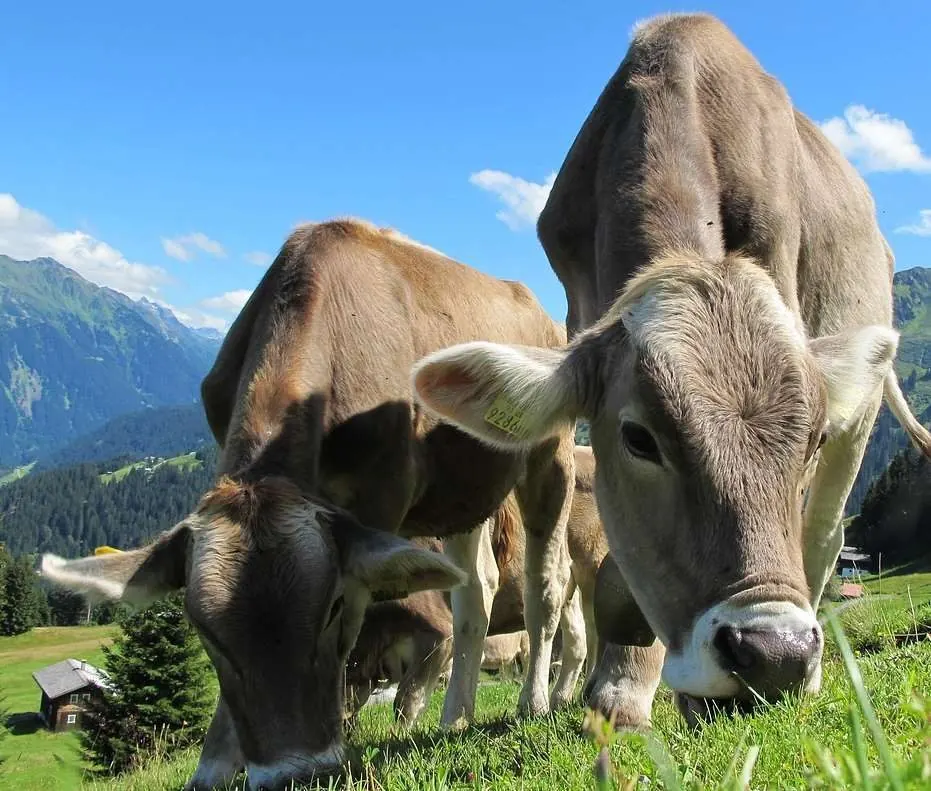
Cattle · Summer
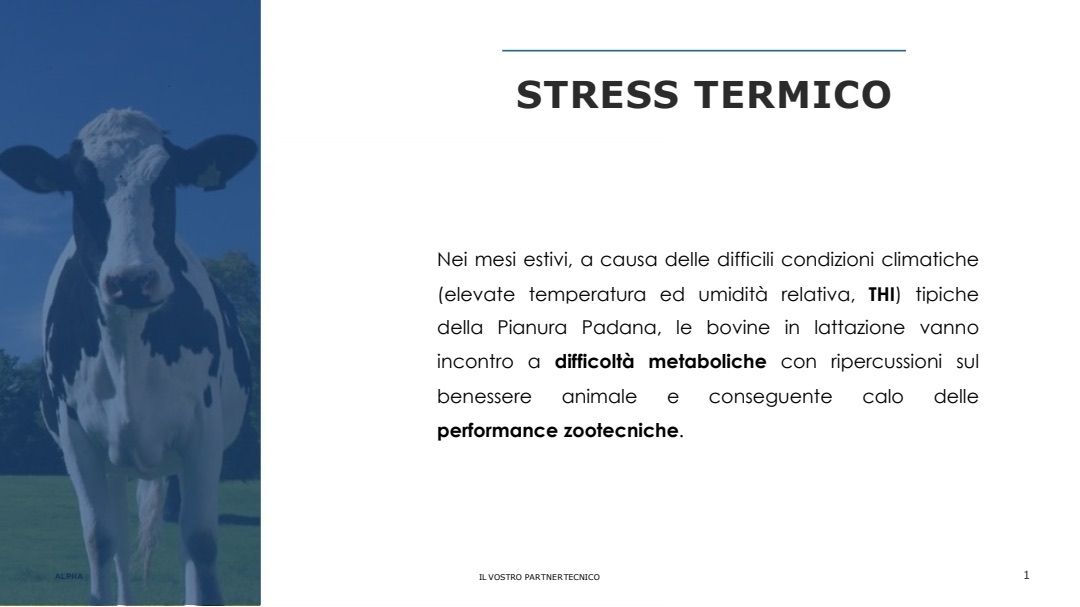
Heat stress
In the summer months, because of the difficult climatic conditions (high temperature and relative humidity, THI) typical of the Po Valley, lactating cows face metabolic difficulties, with effects on animal welfare and a resulting drop in performance.
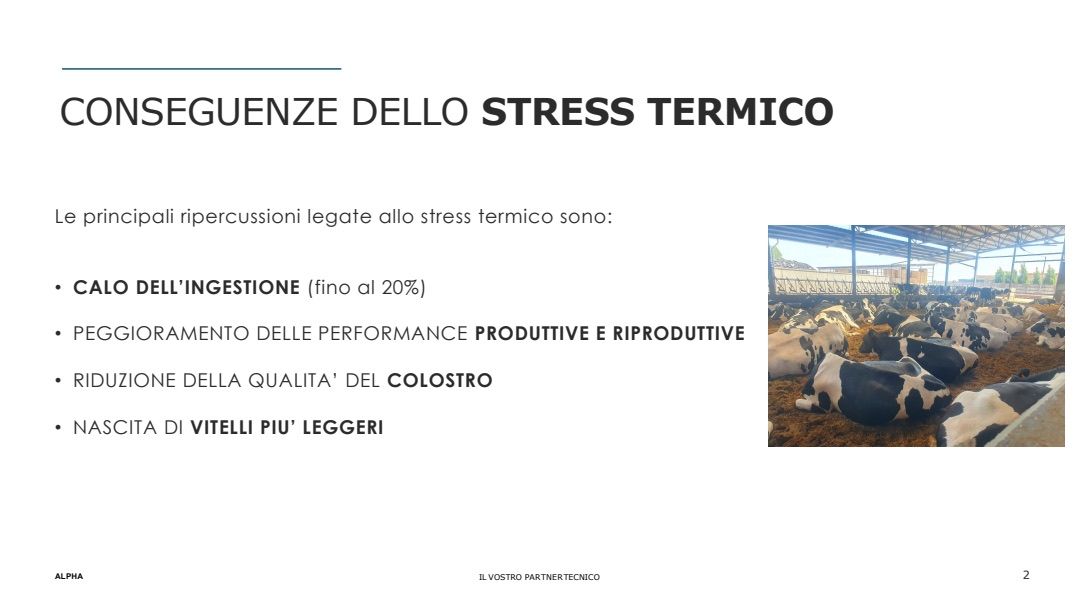
Consequences of heat stress
The main effects of heat stress are:
- Lower feed intake (up to 20%)
- Poorer productive and reproductive performance
- Lower colostrum quality
- Birth of lighter calves
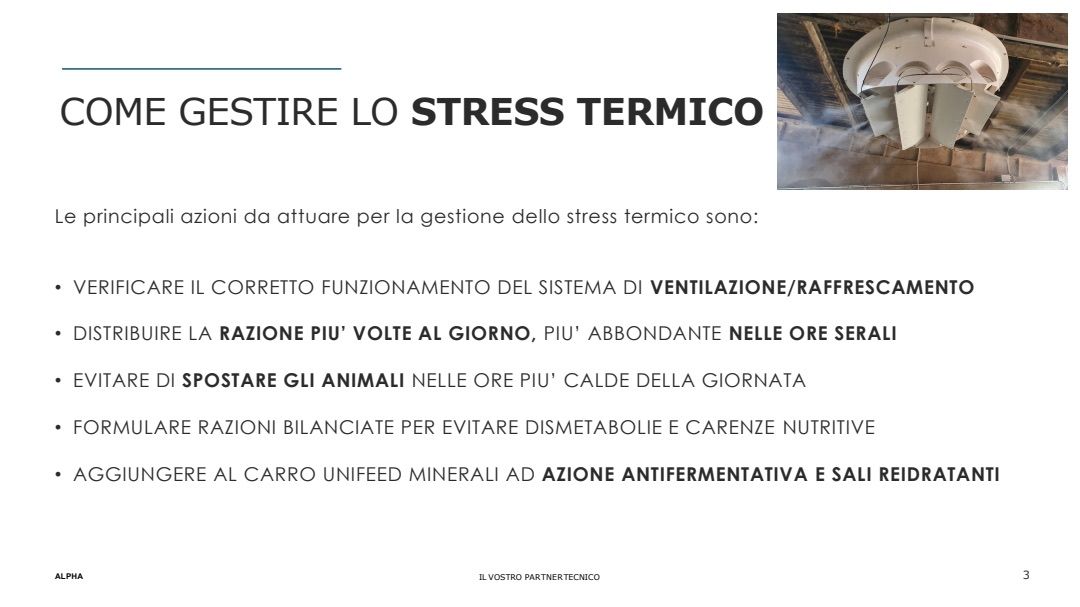
How to manage heat stress
The main actions for managing heat stress are:
- Check that the ventilation/cooling system is working properly
- Distribute the ration several times a day, with more in the evening
- Avoid moving animals during the hottest hours of the day
- Formulate balanced rations to avoid metabolic disorders and nutritional deficiencies
- Add minerals with an anti-fermentative action and rehydrating salts to the TMR (unifeed) mixer wagon
Feeding solutions for managing heat stress
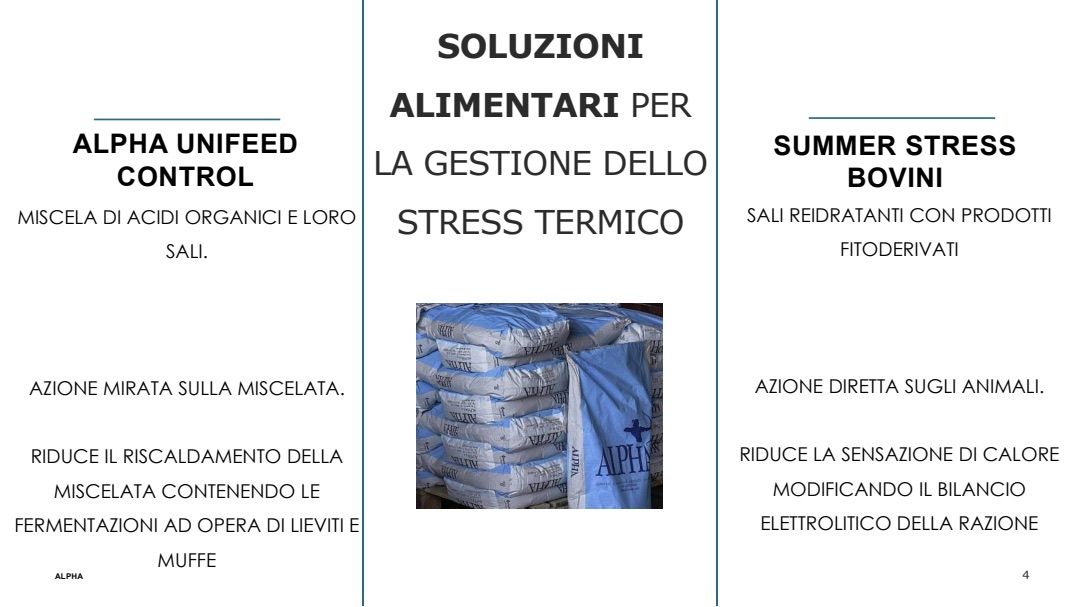
Alpha Unifeed Control
A blend of organic acids and their salts. Targeted action on the mixed ration. Reduces heating of the mixed ration by limiting fermentation by yeasts and moulds.
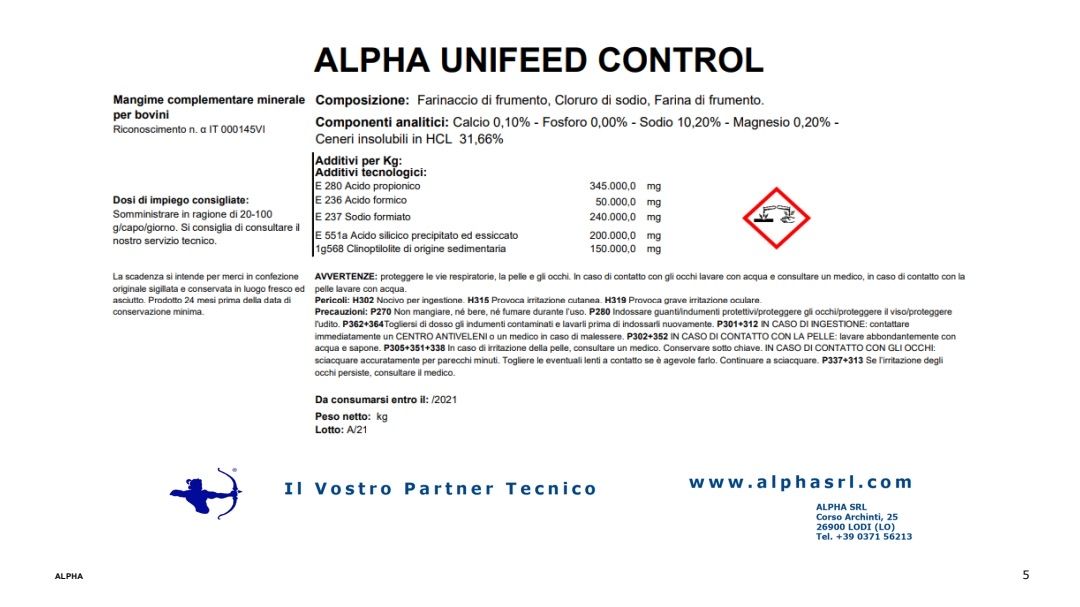
Mineral complementary feed for cattle. Composition: wheat middlings, sodium chloride, wheat flour. Recommended dosage: feed at 20-100 g/head/day. We recommend consulting our technical service.
Summer Stress Bovini
Rehydrating salts with plant-derived products. Direct action on the animals. Contributes to the electrolyte balance of the ration in hot periods.
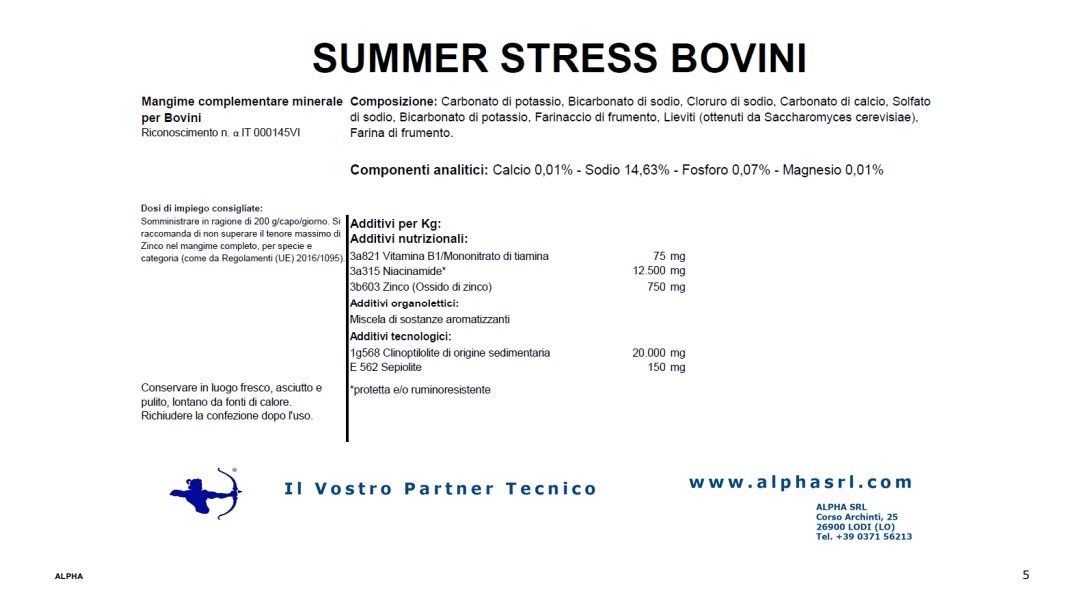
Mineral complementary feed for cattle. Composition: potassium carbonate, sodium bicarbonate, sodium chloride, calcium carbonate, sodium sulphate, potassium bicarbonate, wheat middlings, yeasts (obtained from Saccharomyces cerevisiae), wheat flour. Recommended dosage: feed at 200 g/head/day. Do not exceed the maximum zinc content in the complete feed, by species and category (as per Regulation (EU) 2016/1095).
The full composition, analytical constituents, additives and warnings are given on the labels (slides 6 and 7, in Italian).
The presentation slides
Select a slide to enlarge it (slides in Italian).

Tools on this page
Calculation tool
THI and summer plan for dairy cows
The THI (temperature-humidity index) combines temperature and relative humidity. Enter the values in your barn to see the heat stress band, the daily doses for the herd and the kilograms to prepare for the summer.
THI
Mild to moderate stress
Daily doses for the herd
- Alpha Unifeed Control
- kg/day
- Summer Stress Bovini
- kg/day
Summer plan: hot days
- Alpha Unifeed Control in total
- kg
- Summer Stress Bovini in total
- kg
THI 79.8: mild to moderate stress. For 100 cows: Alpha Unifeed Control 2–10 kg a day, Summer Stress Bovini 20 kg a day. For 30 days of heat: 60–300 kg of Alpha Unifeed Control and 600 kg of Summer Stress Bovini.
Heat stress bands
- No stress below 68
- Threshold of stress 68 to 71.9
- Mild to moderate stress 72 to 79.9
- Moderate to severe stress 80 to 89.9
- Severe stress 90 and above
Working bands: 68 from Zimbelman et al. 2009; 72, 80 and 90 from the Collier/Zimbelman table (University of Arizona). These are not Alpha data: to be validated with Alpha’s technical service. NRC formula (1971): THI = (1.8 × T + 32) − (0.55 − 0.0055 × RH) × (1.8 × T − 26), with T in °C and RH in %.
Checklist: how to manage heat stress
Your ticks are saved on this device.
Recommended doses
Doses of Alpha products for heat stress Product Dose Alpha Unifeed Control 20–100 g per head per day (targeted action on the mixed ration) Summer Stress Bovini 200 g per head per day (direct action on the animals) In hot weather intake can fall by up to 20%: estimate how much with the summer intake drop calculator.
THI and summer plan for dairy cows
Heat stress from temperature and humidity, doses for the herd and a summer checklist.From your barn’s temperature and humidity to the THI, with doses for the herd and a summer checklist.The THI to read heat stress on the farms you follow, with the doses of the summer products.CattleCalculation tool
Summer drop in feed intake
With heat stress, intake can fall by up to 20%. Enter the usual dry matter intake and the number of cows: the calculation shows how much dry matter the herd is missing each day and over a week.
Missing dry matter
- For the herd, each day
- kg
- In a week
- kg
- Per head per day
- kg
- Remaining intake per head
- kg/day
Enter the normal dry matter intake per head: in hot weather it can fall by up to 20%.
Consequences of heat stress
- Drop in intake (up to 20%)
- Poorer production and reproductive performance
- Lower colostrum quality
- Lighter calves at birth
Calculation: loss per head = normal intake × drop %; for the herd × number of cows; for the week × 7.
Summer drop in feed intake
Dry matter the herd loses in hot weather, per day and over a week.Dry matter your herd loses in hot weather, per day and over a week.The summer intake drop to allow for in hot-weather rations, per day and over a week.Cattle
Our areas of work